Iranian Journal of Irrigation & Drainage

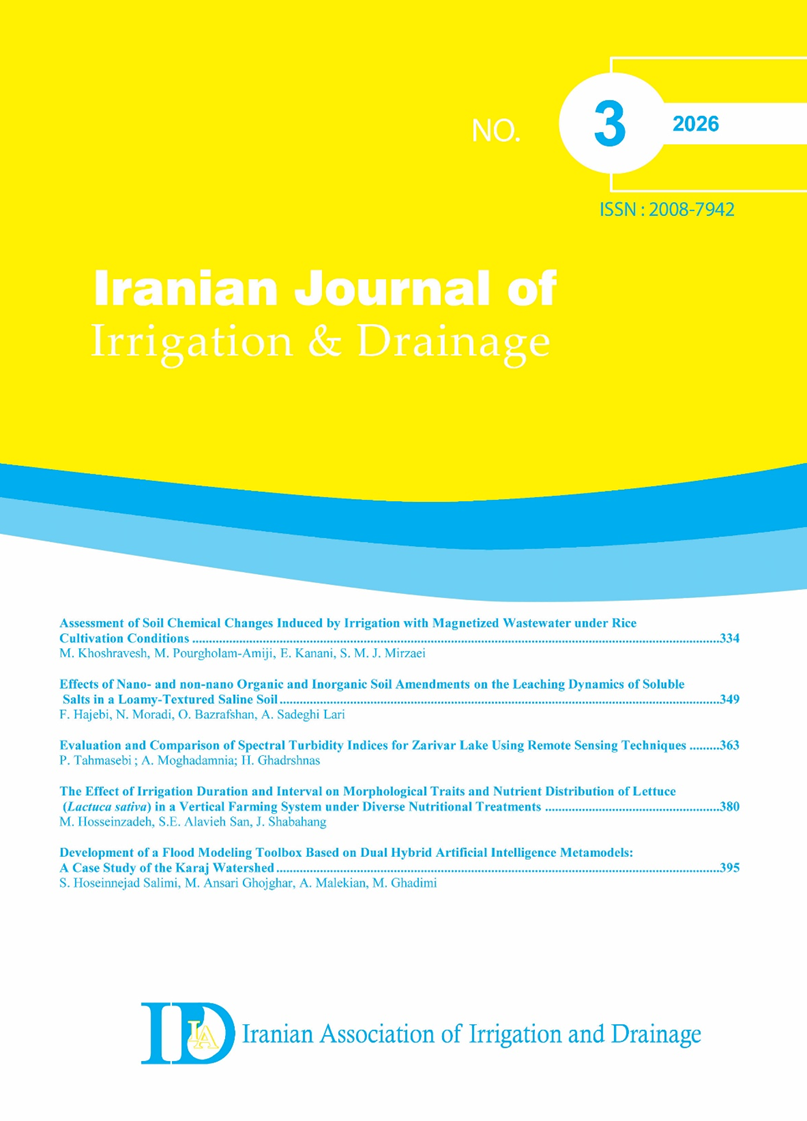
Iranian Journal of Irrigation & Drainage

Iranian Journal of Irrigation and Drainage is a scientific-research publication that has been approved and approved by the Ministry of Science, Research, and Technology. This publication is affiliated with the Iranian Irrigation and Drainage Scientific Association, which has the purpose of publishing research and scientific works of experts in irrigation and drainage science and engineering, as well as related scientific fields such as weather, climatology, water and soil, economics and water rights. , climate change, agriculture, etc. An additional objective of this publication is to establish a context for increasing knowledge and research, scientific-research creativity, and communication between the country's scientific departments, as well as for transferring and exchanging new scientific findings and results

Published by: Iranian Irrigation and Drainage Association

Publication frequency: biannual (scientific)

Arbitration type: Bimonthly

Language of publication: Persian with an English abstract

The publication policy: Open access for all articles

Ranking in the last evaluation of the country's scientific publications: B

This journal is following of Committee on Publication Ethics (COPE) and complies with the highest ethical standards in accordance with ethical laws

Current Issue: Volume 20, Issue 1 - Serial Number 116, May and June 2026, Pages 1-174 

Effect of Sprinkle Irrigation System on Water Productivity of Fresh Mulberry Leaf for Silk Production

Pages 87-99

10.22034/idj.2025.550041.2633

Majid Saber Zideh Saraei, Youssef Hamidoghli, Davoud Bakhshi, Mohammadreza Khaledian, Reza Sourati Zanjani

Optimal location of pumping wells in coastal aquifer using the simulation-optimization model (MLPG - MOIPO)

Pages 130-146

10.22034/idj.2025.545845.2625

Zahra Baazm, Abolfazl Akbarpour, Mostafa Yaghoobzadeh, Seyed Saeid Eslamian, Hossein Khozeymehnezhad

Keywords Cloud

  • Water productivity
  • Yield
  • Deficit irrigation
  • evapotranspiration
  • Water Use Efficiency
  • Groundwater
  • optimization
  • Discharge coefficient
  • Drip Irrigation
  • Salinity
  • Drought
  • Water requirement
  • irrigation
  • water stress
  • Remote Sensing
  • Irrigation management
  • Simulation
  • Water Quality
  • Calibration
  • Climate change
  • Artificial Neural Network
  • soil moisture
  • Wheat
  • AquaCrop
  • Wastewater
  • Surface irrigation
  • Precipitation
  • Corn
  • Production Function
  • climate change
  • virtual water
  • Sensitivity analysis
  • Agriculture
  • Furrow irrigation
  • Drought stress
  • Water Table
  • Food Security
  • Modeling
  • Flow-3D
  • Reference Evapotranspiration
  • Lysimeter
  • Uncertainty
  • Water resources
  • subsurface drip irrigation
  • GIS
  • Regression
  • Soil texture
  • heavy metals
  • Green water
  • Pressurized irrigation
  • Interpolation
  • runoff
  • Validation
  • Irrigation system
  • water footprint
  • Urmia Lake
  • Nitrate
  • evaluation
  • Hydraulic conductivity
  • Proline
  • Flow Pattern
  • LARS-WG
  • salinity stress
  • FAO Penman-Monteith
  • Water balance
  • Biomass
  • Efficiency
  • Grain yield
  • SWAT
  • Sustainable agriculture
  • land use
  • performance
  • AquaCrop model
  • Crop coefficient
  • Compound channel
  • prediction
  • Scour
  • Physical Model
  • Blue water
  • Seed yield
  • GMS
  • Chlorophyll
  • Downscaling
  • Crop Modeling
  • time series
  • planting date
  • Leaf area index
  • Electrical conductivity
  • Irrigation water
  • aquifer
  • SWAT model
  • Infiltration
  • Distribution Uniformity
  • Positive Mathematical Programming
  • Hydraulic jump
  • NDVI
  • Kriging
  • sugarcane
  • Porous media
  • Sprinkler Irrigation
  • Greenhouse
  • Genetic Algorithm
  • scaling
  • Irrigation scheduling
  • MODFLOW
  • Neural Network
  • Irrigation network
  • Application efficiency
  • Laboratory model
  • Trickle Irrigation
  • MODIS
  • LARS-WG model
  • decision tree
  • Desalination
  • Machine Learning
  • satellite images
  • Nitrate leaching
  • Wetting pattern
  • Spur Dike
  • Energy dissipation
  • Water Pollution
  • Water use
  • Zeolite
  • unconfined aquifer
  • Saline Water
  • Data mining
  • Gene expression programming
  • cotton
  • crop yield
  • medicinal plants
  • Water Resources Management
  • Irrigation Networks
  • Virtual water trade
  • Field capacity
  • maize
  • Landsat
  • Hydraulic Gradient
  • Unconventional Water
  • Crop Pattern
  • Golestan
  • Irrigation frequency
  • Random forest
  • cropping pattern
  • Irrigation efficiency
  • Productivity
  • Water management
  • finite volume method
  • groundwater level
  • Seepage
  • Crop water requirement
  • local scour
  • Rainfall
  • evaporation
  • Biochar
  • SWAP model
  • Unsteady flow
  • Paddy field
  • Subsurface Drainage
  • Sedimentation
  • Quality
  • Management
  • Crop model
  • Scenario
  • Applied water
  • HYDRUS-2D
  • Rasht
  • Irrigation planning
  • Pollution
  • flood
  • Temperature
  • Kermanshah
  • HadCM3
  • Vitamin C
  • Inverse modeling
  • Trend
  • soybean
  • Sodium chloride
  • uniformity coefficient
  • Water Salinity
  • Partial Root-zone Drying
  • Standardized precipitation index
  • Magnetic water
  • Kerman
  • Sediment transport
  • GPR
  • Flood Routing
  • Support Vector Machine
  • farmers
  • Khuzestan
  • Wavelet
  • Irrigation methods
  • Soil salinity
  • Tomato
  • Quinoa
  • Evaporation pan
  • Drainage
  • Mulch
  • Scouring
  • Dimensional Analysis
  • debris flow

Related Journals